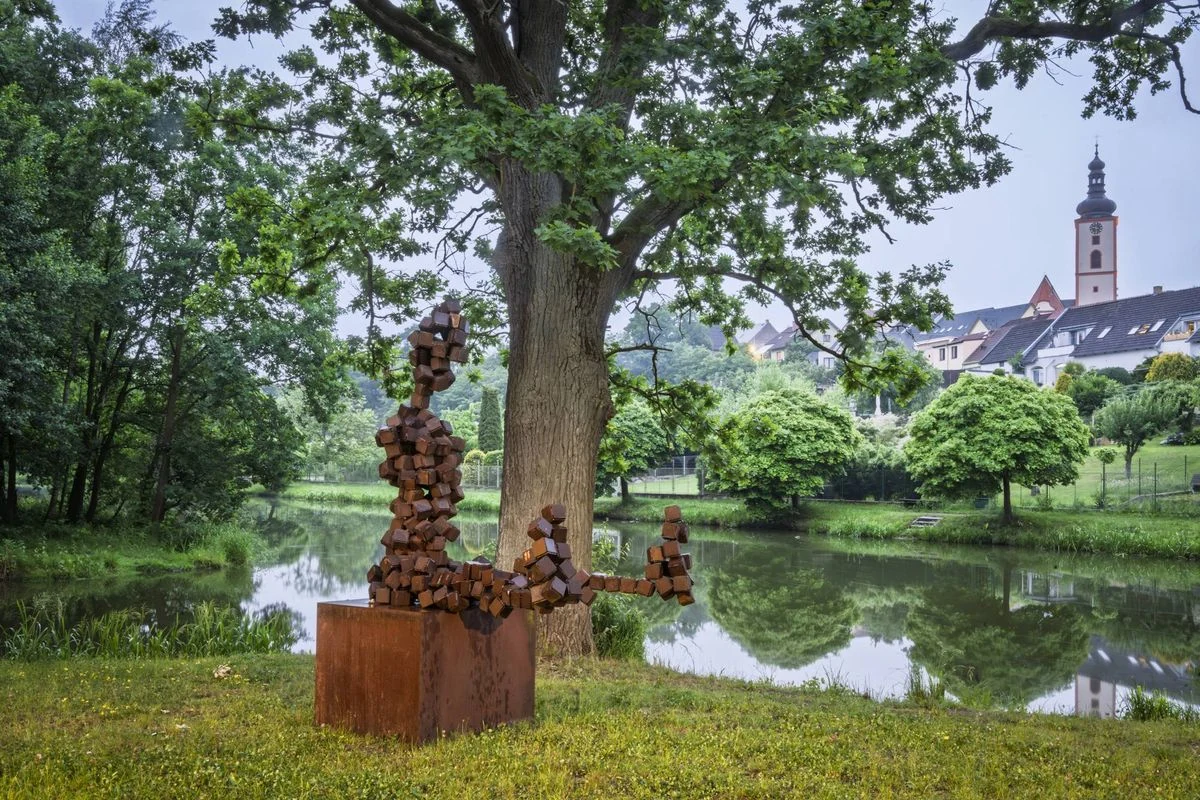
Fear of Change
corten
park u Kulturního domu Veselí nad Lužnicí – třída Československé armády
Frozen in time, unable to move from the spot or to change even the smallest part of oneself.
What the sculpture looks like
"Fear of Change" is a sculpture composed of two clearly distinct parts: a simple, massive plinth and a dynamic, figurative form. The figure is assembled from small lumps and cubes. The whole is monochrome: everything here has a warm, dark brown, in places rusty colour. The sculpture was made of Corten steel. The object carries a certain tension, arising both from its title and from the way the figure is rendered.
Including the plinth, the sculpture is 2.5 metres high and one metre wide. The figure shown occupies a space 2.5 metres deep. The sculpture stands on a cubic steel plinth with one-metre sides. It is a massive, simple block with a rusty brown surface. Its sides are smooth but carry traces of streaks, discoloration and the natural oxidation of the metal.
The figurative part of the object is placed on the plinth. It is a human figure. It is simplified and slightly deformed. It is hard to tell the gender of the figure shown. It is assembled from a multitude of small cubes. All are of similar size, with sides about 15 centimetres long. The same module repeats throughout the sculpture, yet the arrangement of the elements remains irregular. The cubic blocks themselves are slightly irregular. They are also set at various angles. For the most part their faces do not touch one another. Their spacing and slanted arrangement mean that narrow gaps almost always appear between them. Because of this the figure seems to vibrate. The viewer may have the impression that this image was achieved by halting the movement of several dozen small blocks that are constantly balancing and vibrating.
The figure rendered in this way sits on the plinth. Its buttocks and hips are almost at the centre of the plinth's surface. The figure has its legs stretched out and spread apart. The legs are substantial, slightly oversized. They project beyond the edges of the block and hang in the air in front of the sculpture. The figure's feet are enlarged. The toes point upwards.
The torso of the figure is fairly narrow. It is androgynous, resembling neither a male torso nor female breasts. The sculpture has no arms and no hands. The arrangement of the cubes in this part of the sculpture nevertheless suggests that the arms are held close to the body and crossed at chest height.
At the top of the composition is a small head. It has no face and no anatomical detail. It is merely a vertical, angular and slightly elongated form, assembled from the same brown modules as the rest of the work.
The composition works on the principle of contrast. The plinth is simple and heavy. The figure above it is open, looks fragmented and is full of small gaps. From a distance the silhouette of the figure can be made out, but close up the body falls apart into individual pieces.
How to find the sculpture
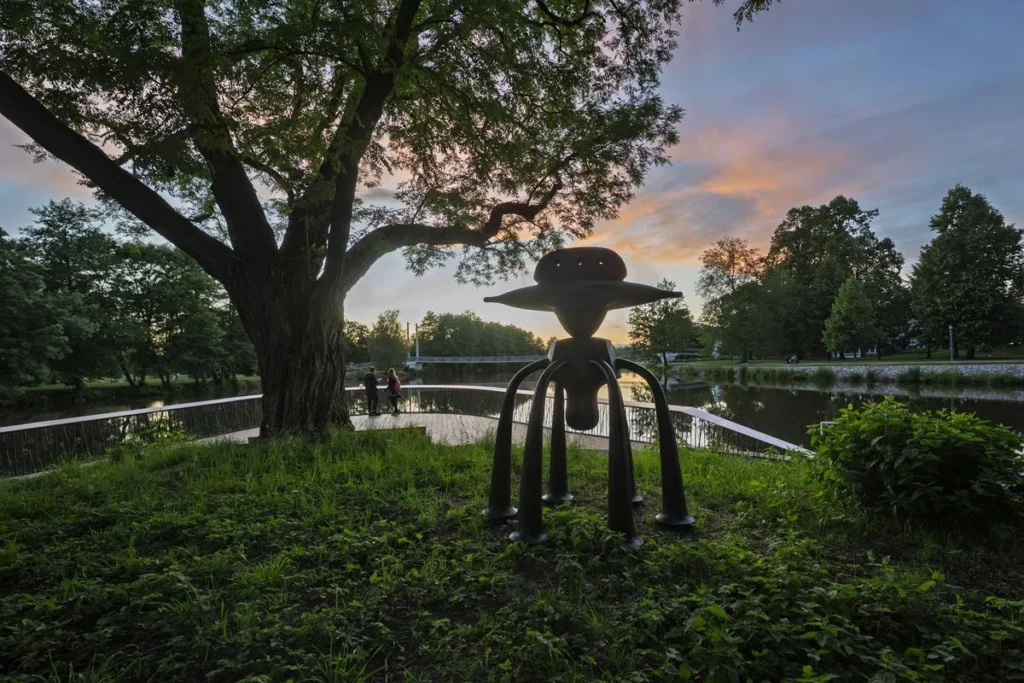
The park by the cultural centre, Československé armády avenue, Veselí nad Lužnicí – near the river by the jetty. The sculpture stands on a cubic steel plinth with one-metre sides; including the plinth it is two and a half metres tall.