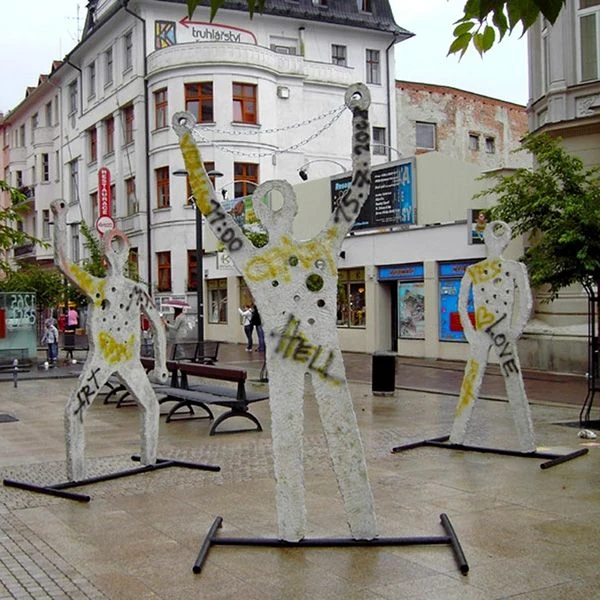
Just as the Ra group was held together by a desire to move beyond surrealism towards classical composition and purely visual elements, and just as the members of the Šmidrové group agreed on the need to free art from all pathos, the 4 Sculptores group was held together by a determination to work in a traditional artistic medium despite a present dominated by conceptual art and digitalisation. Michal Trpák and Jakub Flejšar showed their sculptures on Lannova třída.
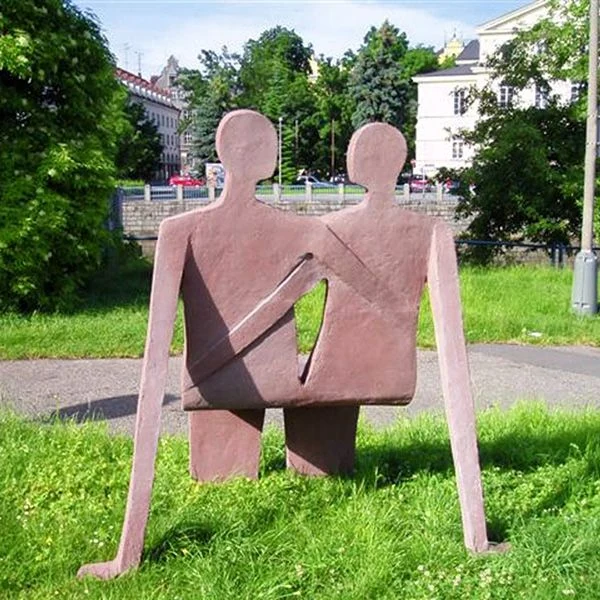
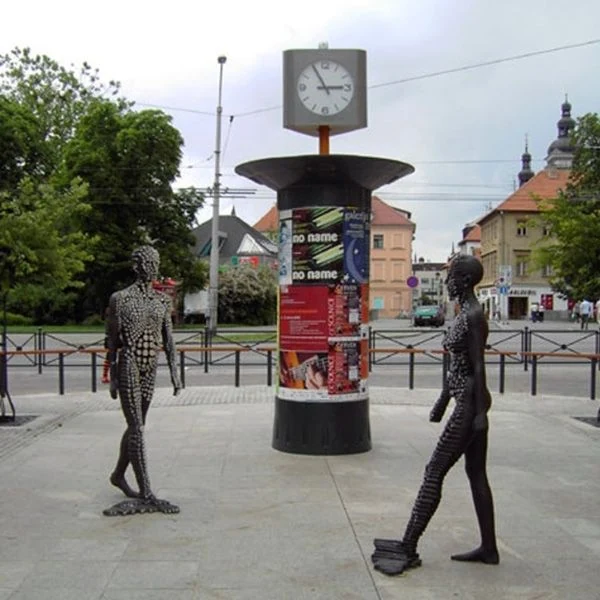
The centre of the new town is a space for meeting, for communication. Both artists therefore showed figurative sculptures there. Trpák's figures of a man and a woman, titled Meeting among Pixels, respond to today's social trend of technological communication, behind which we can sometimes only with difficulty picture an individual. Half of the composition of Trpák's figures remains realistically anthropomorphic; the other half falls apart into the indeterminate form of an abstract digital world.
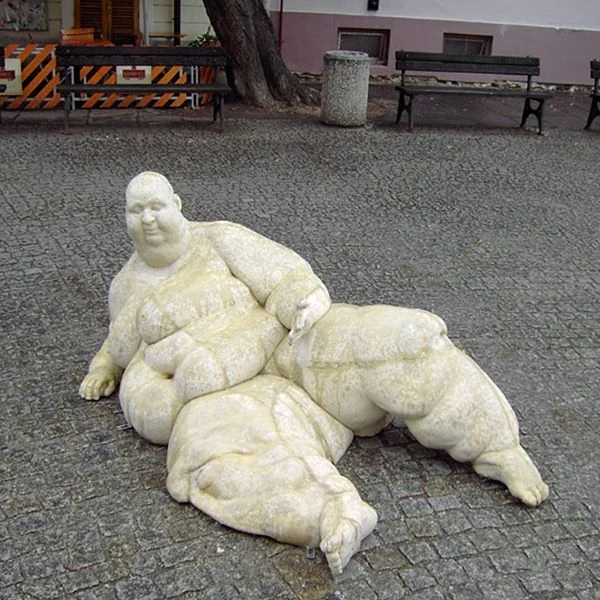
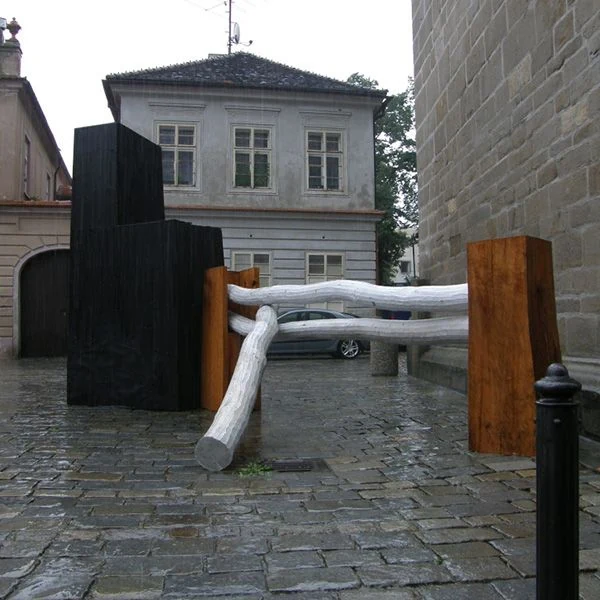
Through the expressive plasticity of his work, Trpák widens the expressive possibilities of sculpture without leaving the classical sculptural medium. Jakub Flejšar used a less traditional material for his Flood Tourists. Flejšar's sculptures are assembled from pieces of unworked wood. He approaches the material with humility and acknowledges its natural structure, which gives the works a raw character recalling the texture of art informel. Flejšar's handling of the material seems effortless — he does not work it further and does not protect it from the passage of time, just as the human body cannot be protected from it. Towards the old town you come across Martin Rajčan's work, installed by the Black Tower.
In his minimalist object Rajčan freed himself from form and from classical plasticity in order to bring the surface to the fore and externalise meaning. The work is completed by the atmosphere of the Black Tower and corresponds with its simple but dignified architecture; at the same time we can imagine it has become a barrier between our world and the world of the astral beings said to appear around this mysterious tower.
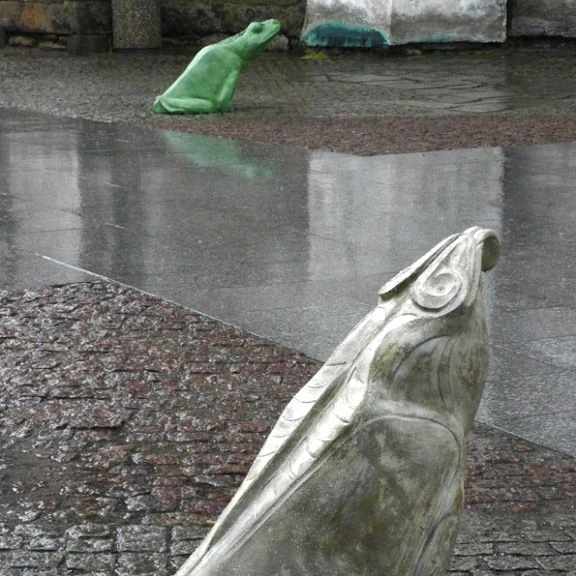
Another legend of České Budějovice directly inspired Světlana Jelenová, who showed three imposing frogs on Piaristické náměstí. Legend has it that a treasure was once buried where the Piarist church now stands, guarded by an enormous frog. The frog did not move even when the builders began digging the foundations of the monastery and the church. It simply climbed the tower, little by little, until it turned to stone. The legend says that when the frog reaches the very top of the tower, the world will end. Světlana Jelenová's frogs, by contrast, carry a positive message. Touch the frog with the jewels on its head and wealth awaits you; the frog with the poisonous mushrooms will give you wisdom, and the Egyptian frog strength and fertility.
The last work has become part of the city itself. Michal Trpák's bench on Zátkovo nábřeží is an interactive sculpture that invites the viewer not only to look at it but to sit down and feel the work for themselves. In closing, let me quote the Czech theorist of sculpture Petr Rezek, who caught the spirit of sculpture as an art of space and touch: “Sculpture comes alive, and its power tells above all where it has reality at its disposal.” I think it was precisely this great truth that the four sculptors had in mind when they set out their works in the streets of České Budějovice.
The city offered the artists a generous space in which the sculptures can work through their energy and give the viewer a chance to discover and feel their plasticity. The sculptors linked parts of the city through their art, supported its genius loci and created, or completed, its story.
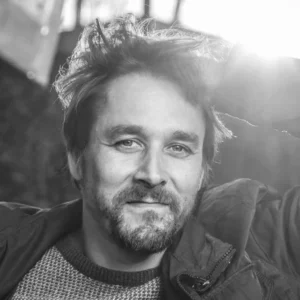
Michal Trpák
sculptor and founder of the exhibition