Wolf Soap
Fibreglass, wooden frame
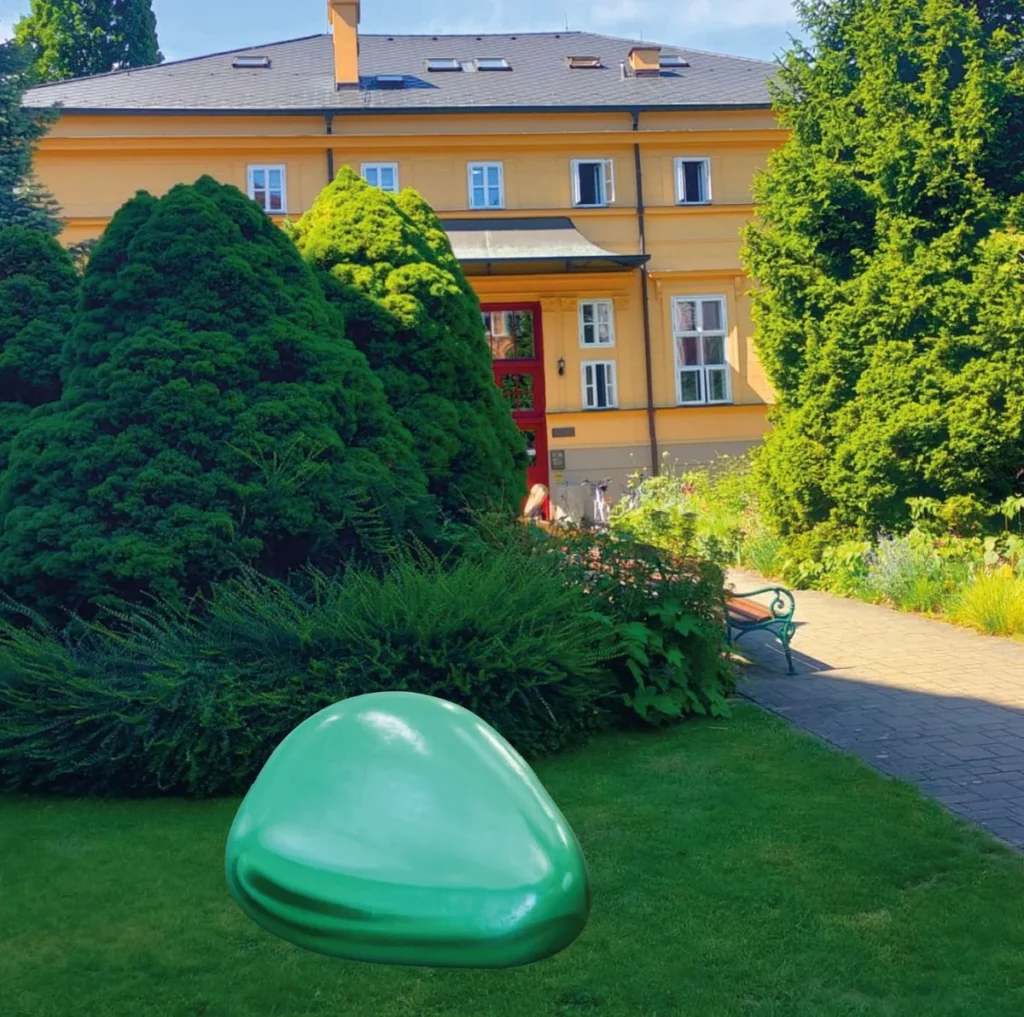
U Černé věže – dvorek restaurace Naše farma
At the centre of the proportions of the picture is a drawn man, inspired by the Vitruvian Man. On the one hand the drawing is a symbol of humanism, expressing the conviction that the harmonious beauty of both people and the world rests on the proportions of the human body; on the other it is an intuitive image of the pressure of the outside world on a person and of the fragility of the mind itself.
What the sculpture looks like
Wolf's Soap is a square relief sculpture hung on a wall. The object takes the form of a large panel in light grey. Each side of the square measures roughly one metre. Seen from the front it resembles a painting or a decorative panel. Seen from the side, however, it is clear that this is a spatial relief. In some places the modelling projects as much as ten centimetres in front of the base plane.
The whole work is monochrome, greyish and matt. The surface has a mostly fine grainy structure. The sculpture consists of two clearly distinct parts. In the middle is the smooth silhouette of a human figure shown in profile. Around it spreads a dense, strongly raised background made up of a multitude of rounded forms. The difference between the two parts is very marked: the figure is flat, calm and almost without detail, while the surrounding space swells, undulates and fills the entire panel.
A human figure occupies the centre of the composition. It is not shown realistically or with anatomical accuracy. It is a simplified soft silhouette, probably of a male figure. It is naked, with a bare head and no facial detail. It is caught in a crouch. It gives the impression of having just squatted down, or of moving very slowly on bent legs.
The back forms a large, softly modelled arc leaning towards the left of the composition. The torso is bent forward. One arm hangs down in front of the body. The legs are bent and drawn in towards the body. Their position is suggested by simplified planes and by lines of tiny pitted hollows. One knee projects at the lower left edge of the figure. The other leg is more hidden beneath the torso.
The figure is not anatomically worked out. It reads more as a sign for a human body than as a realistic depiction of one. Its silhouette is defined by a broad, flowing contour accompanied by rows of small hollows. They trace the head, back, belly, arm and legs. They also appear inside the silhouette, suggesting knees, ankles or an ear. They resemble the traces of regular piercing or perforation.
The background around the figure is the most raised part of the relief. It consists of hundreds of rounded forms resembling pebbles, grains, capsules or bars of soap. Their size changes gradually. Towards the edges of the panel they grow larger and gain volume, especially at the sides and in the corners. Close to the figure they are smaller, more densely arranged and seem to adapt to its outline.
In the upper part these rounded forms combine into horizontal, gently undulating bands. At the sides they curve, thicken and flow around the central silhouette. In the lower part they create a heavier and more irregular layer.
The relief works above all with contrast. The human body is smooth, calm and subdued. The space around it, by contrast, is alive, broken up and full of small protrusions. While the figure seems closed in and concentrated, the surrounding mass encircles and almost swallows it.
How to find the sculpture
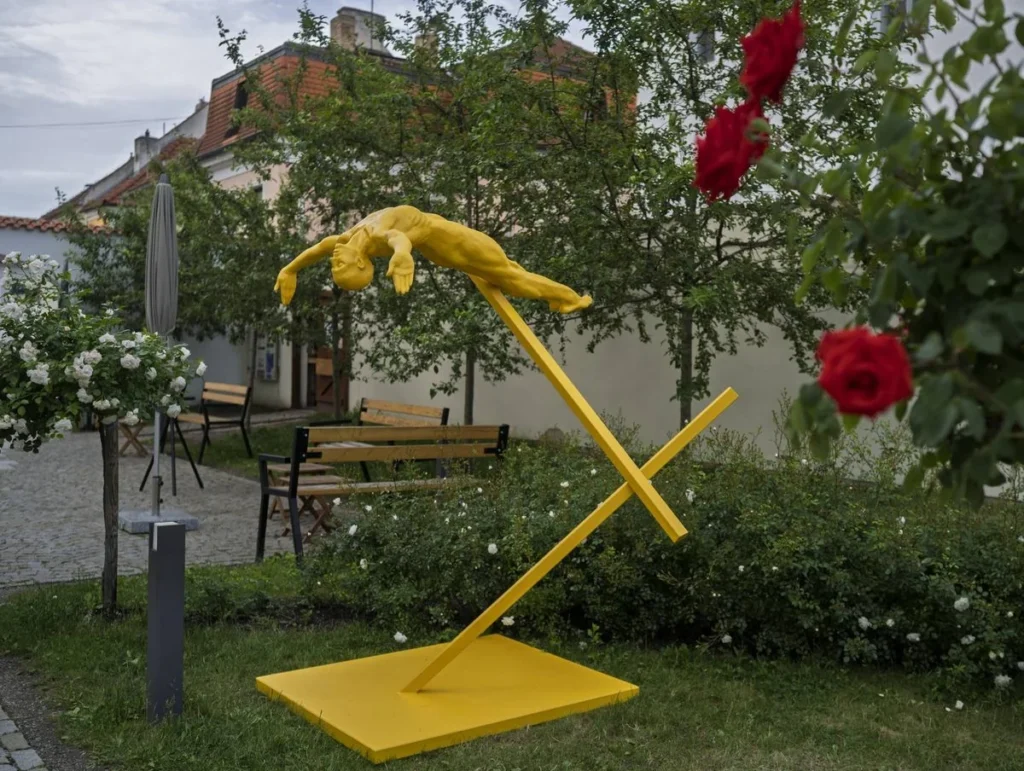
By the Black Tower, České Budějovice – in the courtyard of the Naše farma restaurant. The sculpture stands in an enclosed courtyard, accessible during the restaurant's opening hours.