Chubby and Connection with…
iron, coloured lacquer
There is nothing but figure and ground — Gestalt psychology tells us that our perception organises the visual field into a figure (the object of interest) and a ground (its surroundings). The figure is in front, the ground is less distinct and recedes. Is that the case here as well?
What the sculpture looks like
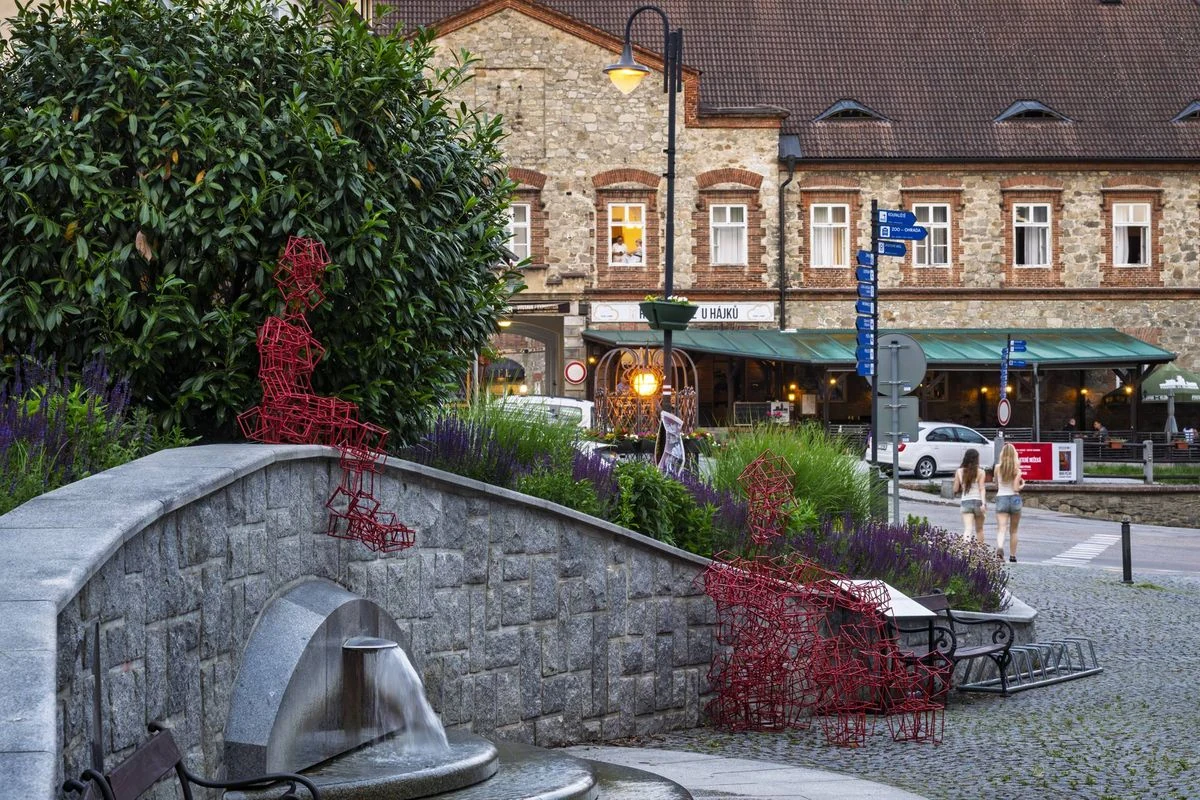
Both sculptures are the work of Jakub Flejšar. The objects stand by Československé armády Square. They are made of iron and coated with red lacquer. They have a light, open construction. These are not solid masses but spatial drawings made of metal rods. The rods create the outlines of human figures. It looks as if someone had drawn a person in the air with a red line, then stiffened that line and left it standing in space.
The composition consists of two separate figures about three metres apart. The larger of them stands on the pavement below a low stone wall. It is called Connection with…. It is 220 centimetres high, 100 centimetres wide and 50 centimetres deep. The second, smaller figure sits on the wall. It is called Chubby. It is 160 centimetres high, 50 centimetres wide and 50 centimetres deep. Both sculptures are red, open and made of similarly arranged thin straight rods.
Connection with… is the larger of the two figures. It stands lower down, beside the stone wall at pavement level. It represents a seated human figure. The body is neither smooth nor realistic. It consists of a multitude of straight iron rods joined at various angles. From these lines emerge a head, torso, arms and legs. The whole recalls a spatial net or a technical sketch of a person. The figure has no face, no eyes, no mouth and no details of clothing. It captures only the basic arrangement of a human body.
The figure sits low, close to the wall. The lower part of the body is broad and strongly developed. The legs are bent, set low above the ground and formed by open rectangular segments. Above them the torso rises as a vertical irregular structure of metal rods. The head is simplified. It takes the form of a small angular volume made of several connected lines. The whole figure is transparent. Everything behind it can be seen through its body.
The second sculpture, Chubby, is placed higher, on the stone wall. It is smaller and also red. It sits on the top edge of the wall. Part of its body rests on the horizontal surface while one part hangs down along the wall. Here too it is not a solid mass. The figure is made of a net of iron rods creating the outline of a head, torso and limbs.
Chubby has a more compact silhouette than the figure standing on the pavement. Its body is shorter and more densely built. The head is set high above the torso and has an irregular angular shape. The whole body recalls a system of small open cages. These do not create a soft anatomy but a geometrically broken form of a seated figure. The name Chubby feels almost ironic here. The sculpture is neither rounded nor plump. On the contrary, it is made of sharp lines, empty spaces and a metal net.
Both figures are a pronounced red. This makes the thin metal rods stand out clearly against the stone, the greenery and the urban surroundings. The red also makes their shape easy to read despite the open construction.
These are not realistic portraits of people. The sculptures do not show age, gender, facial expression or clothing. They capture rather the arrangement of a human figure in space. Both can be read as figures separated from their surroundings and at the same time strongly connected to them. The background remains visible through their bodies. The stone, the plants, a bench, the street and the people behind them all become part of the resulting image.
A comment by the artist Jakub Flejšar refers to the principles of Gestalt psychology. According to it, our perception divides an image into figure and ground. The figure is what we focus our attention on. The ground recedes into the background. These sculptures, however, call that idea into question. The red figures do form a figure, yet they are at the same time full of openings and gaps. The ground behind them does not disappear. On the contrary, it enters directly into their bodies. The sculptures can thus be understood as a play between presence and emptiness, or as a reminder of the tension between human presence and the space a person inhabits.
How to find the sculpture
Československé armády Square, Hluboká nad Vltavou. There are two objects: the larger stands on the pavement below a low stone wall, the smaller one lower down beside the wall at pavement level. Both can be reached from the pavement.