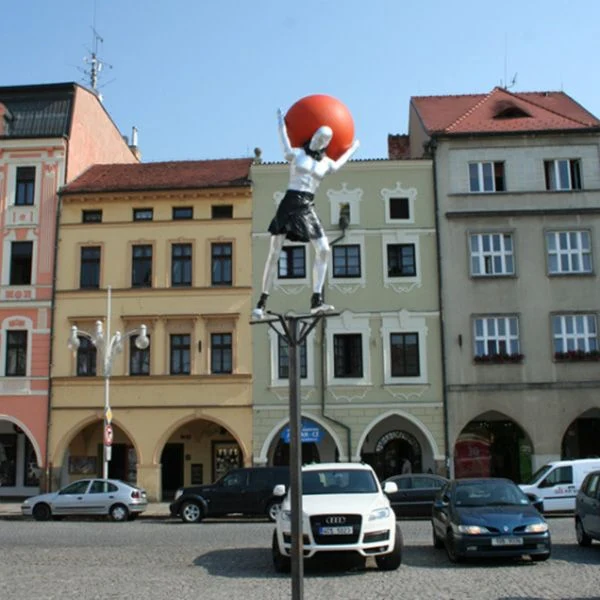
Just as varied are the other works you can see on Sokolský ostrov and on the blind arm of the Malše. A viewer might feel there is no continuity between the individual works, that they are merely artefacts strayed by chance from workshops and studios into the streets. And yet there is a significant unifying element to the exhibition: the city. As a sociological phenomenon the city is not homogeneous; on the contrary, it is a structure internally uneven, even disharmonious.
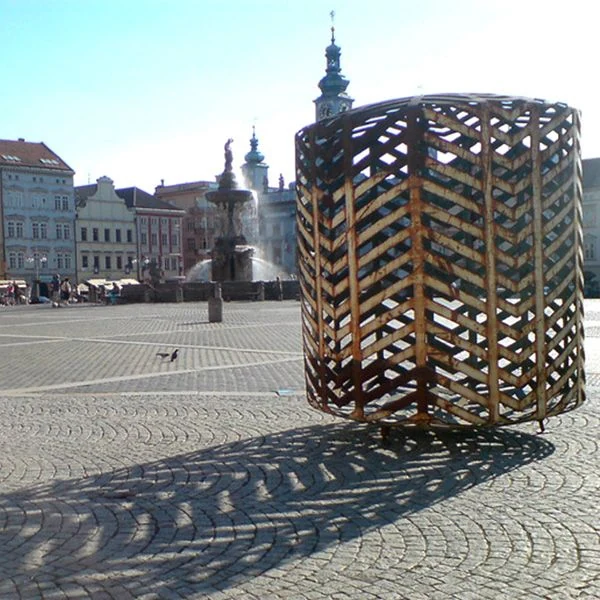
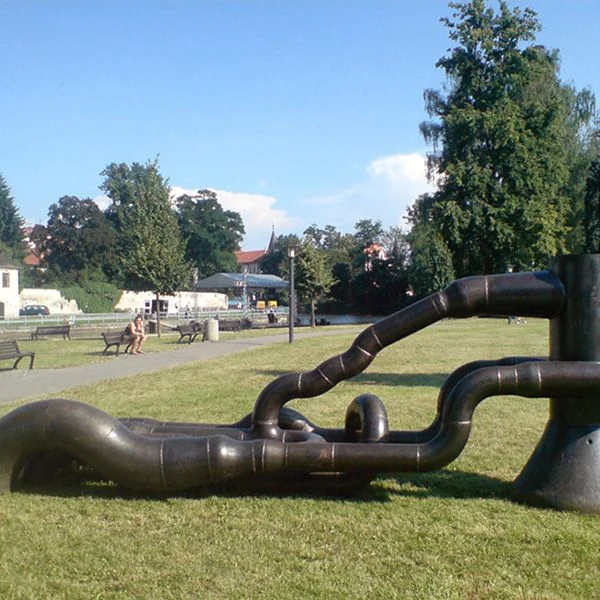
On the one hand it is an important social and cultural unit, on the other the industrial epicentre of its region. Parallels to these faces of the city can be found symbolically in the exhibition opening today. With some exaggeration we might liken one line of the show to an industrial aesthetic. I have in mind above all Čestmír Suška's Rusty Flowers and Lukáš Rais's Leg, which you can see on Sokolský ostrov.
The material of both works is a raw industrial product, aestheticised and shaped by the artist. While Čestmír Suška works with one large piece of rusted cylinder, cutting into it fragile flowers that contrast with the material, Lukáš Rais assembles individual steel tubes into firm bundles that together make a particular shape. Another striking element of the exhibition is Michal Trpák's sculpture and Ladislav Plíhal's object, which reflect the social aspect of the city.
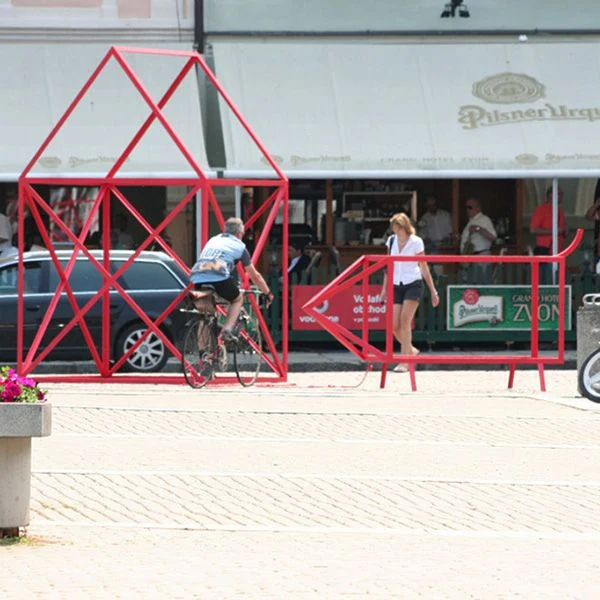
Plíhal's work Little House and Piggy gives three-dimensional form to a notoriously familiar figure, which we might regard as an early expression of street art. Street art, today establishing itself as an unofficially recognised artistic genre, has become an inseparable part of every city. We come across it so often and in such everyday places that we have reduced our reception of it to mere registration.
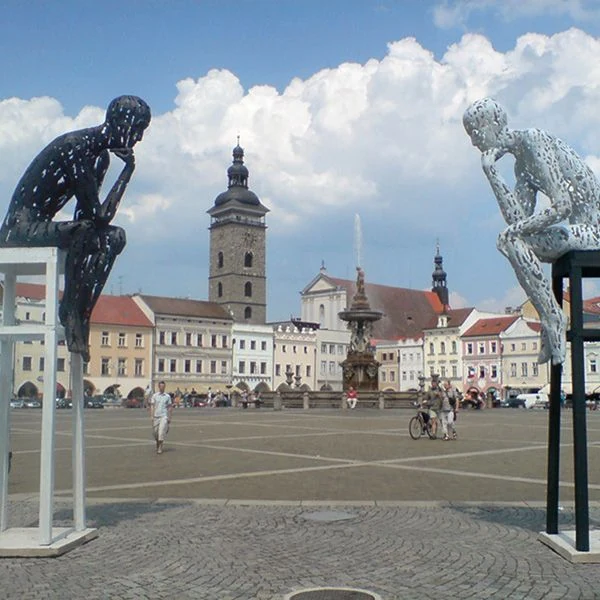
Perhaps it is precisely street art stepping out into space that can sharpen our perception of an ordinary day. Michal Trpák captures the social movement of the city from another angle, paraphrasing Rodin's Thinker. Trpák exposes his Thinker to dialogue with another, placing him in the paradoxical coexistence of two individuals. With this work Trpák raises several fundamental questions: he symbolically points to the difficulty of grasping the role of the individual in the anonymous society of the city, where the individual remains subjectively the central point of everything, turned entirely inward to themselves and to the problem of their own being, while objectively they are lost in the crowd and, seen that way, their existence is negligible. Placing the sculpture directly in front of the town hall, the significant building of every city meant for citizens to meet in, opens a wide range of possible readings.
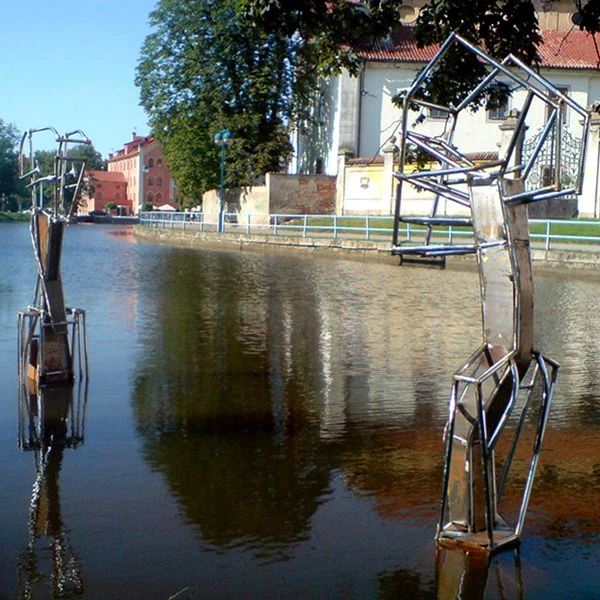
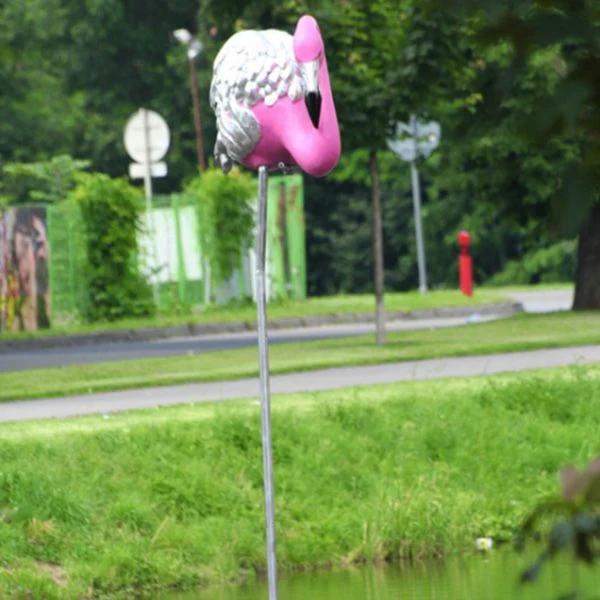
The sculptures by Jakub Flejšar and Zuzana Beránková standing on the blind arm of the Malše also correspond with where they are placed. The river, meant in the summer months to be above all a place of fun and relaxation, has gained a new cultural dimension thanks to Zuzana Beránková's Flamingo and Jakub Flejšar's Descending Figures. Both sculptures soften and aptly complete the urban character of the setting they are placed in. The Art in the City 2010 exhibition certainly brings the city to life, pulls the visitor out of the everyday and offers intimately familiar places to be perceived in an entirely different way — a perception freed from the practical and utilitarian needs of an ordinary day.
In closing I would like to wish the artists that their works meet with nothing but favourable responses, and that if critics are found after all, they are only constructive and not destructive, as they were at the sad exhibition here in Budějovice in 2008. Because, as Jan Werich said: “Art is like the sun, which does not force itself on anyone either. If you draw the curtains and close the shutters, the sun will not come into your flat — only it is your own fault that you want to live in the dark.” So draw back the curtains, open the shutters and enjoy this summer exhibition.
Michal Trpák
sculptor and founder of the exhibition