Face to Face
wood, jointing material
Park Čtyři Dvory, ul. Milady Horákové
A duel between two individuals who, in the strength of their positions, are looking for a shared way forward… which is still nowhere to be found…
What the sculpture looks like
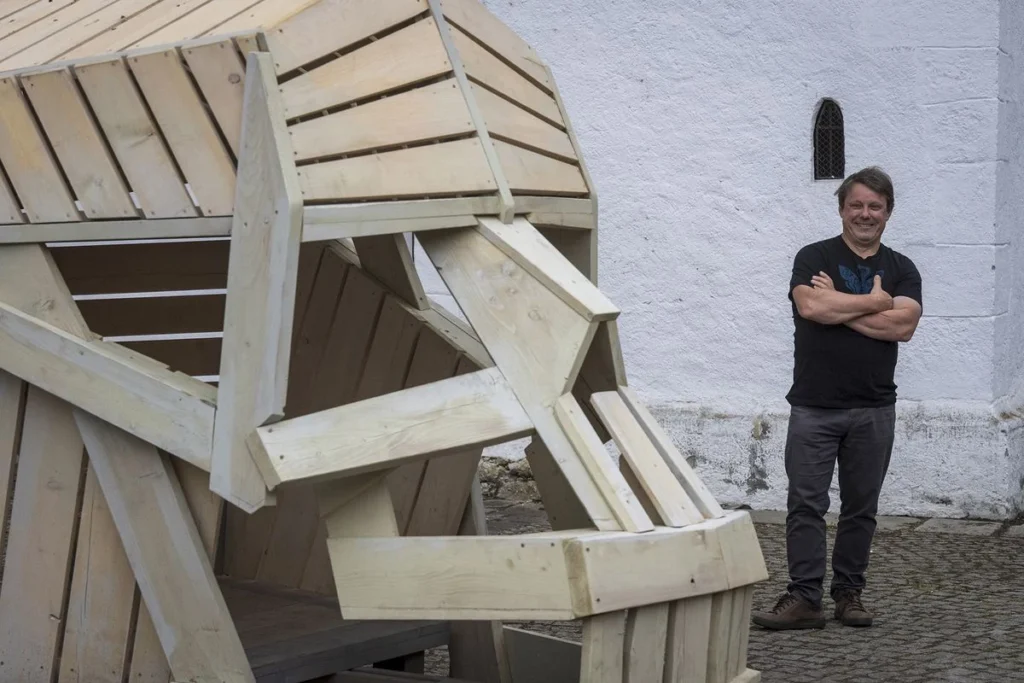
The sculpture is called Face to Face. It is a large, open structure made of wooden beams and battens. It takes the form of a gate or a tall frame placed above a path covered with wood chips. The object is considerably larger than a person. It reaches roughly eight metres in height and measures about six metres at its widest point.
The structure stands on four slanting supports. Two are to the left of the passage and two to the right. Each support is made up of several long, straight beams. The beams are tilted and connected by cross members. Together they create triangular structures recalling technical scaffolding. The lower ends of the supports are anchored in small rectangular foundations laid on the ground.
Long diagonal parts of the structure continue upwards from the supports. They converge from both sides above the passage and carry the upper part of the sculpture. Because of this the centre of the structure stays empty. It is possible to walk underneath the sculpture. Its lower part works as a gate: load-bearing elements resembling legs stand at the sides, and overhead spreads an extensive construction of beams and battens.
The highest part of the sculpture takes the form of an irregular spatial mass. It is not closed. It consists of a multitude of wooden battens crossing at various angles. Some run horizontally, others vertically, diagonally or right across the space. Some of their ends project beyond the main outline of the object. The upper part therefore looks frayed and has an irregular, jagged silhouette.
Relative to the overall size of the object, the beams and battens are fairly slender. Their arrangement is dense yet at the same time airy. A great deal of open space remains between the individual elements. Seen close up, it is clear that the structure is not perfectly regular. Some battens are straight, others slightly bent or twisted. Some are shorter and recall broken-off pieces of larger elements. In several places the joints are reinforced with screws and metal connectors.
The wood is grey and matt. In places it shifts into dark brown or almost black tones. The surface looks raw and long exposed to the weather. Growth rings, changes of colour, cracks and other irregularities are visible on it. Some beams are lighter, others darker, so the structure does not read as uniform in colour.
The lower supports are arranged more regularly than the upper part. They are formed by long elements assembled into clearly legible triangles. The top of the sculpture, by contrast, is much denser and more complex. It resembles a spatial tangle of wooden battens. This is where most of the short elements, crossings and gaps are found.
To some people the lower part of the sculpture may recall the legs and parts of the bodies of wrestlers grappling with each other. Legs slightly bent at the knee can be made out in the slanting supports. Above them, however, the form breaks up into a non-figurative jumble of structural elements in which it is no longer possible to look for particular parts of human bodies.
How to find the sculpture
Čtyři Dvory park, Milady Horákové street, České Budějovice – next to Park Café. The sculpture takes the form of a gate or tall frame above a path covered with wood chips, resting on four slanting supports. You walk right underneath it; the path surface is soft.