Concrete Garden
concrete
An installation from a series of concrete sculptures inspired by the shapes of flowers and buds. The project explores the relationship between nature and the built environment, with concrete serving both as a material and as a metaphor for human intervention in the landscape. Flowers, traditional symbols of growth and renewal, are transformed here into a solid concrete form that speaks of urbanisation, ecological pressure and the human need for control. I do not see blossoming as a harmonious culmination, but as a bursting open — a moment of opening, tension and vulnerability, held permanently in place.
What the sculpture looks like
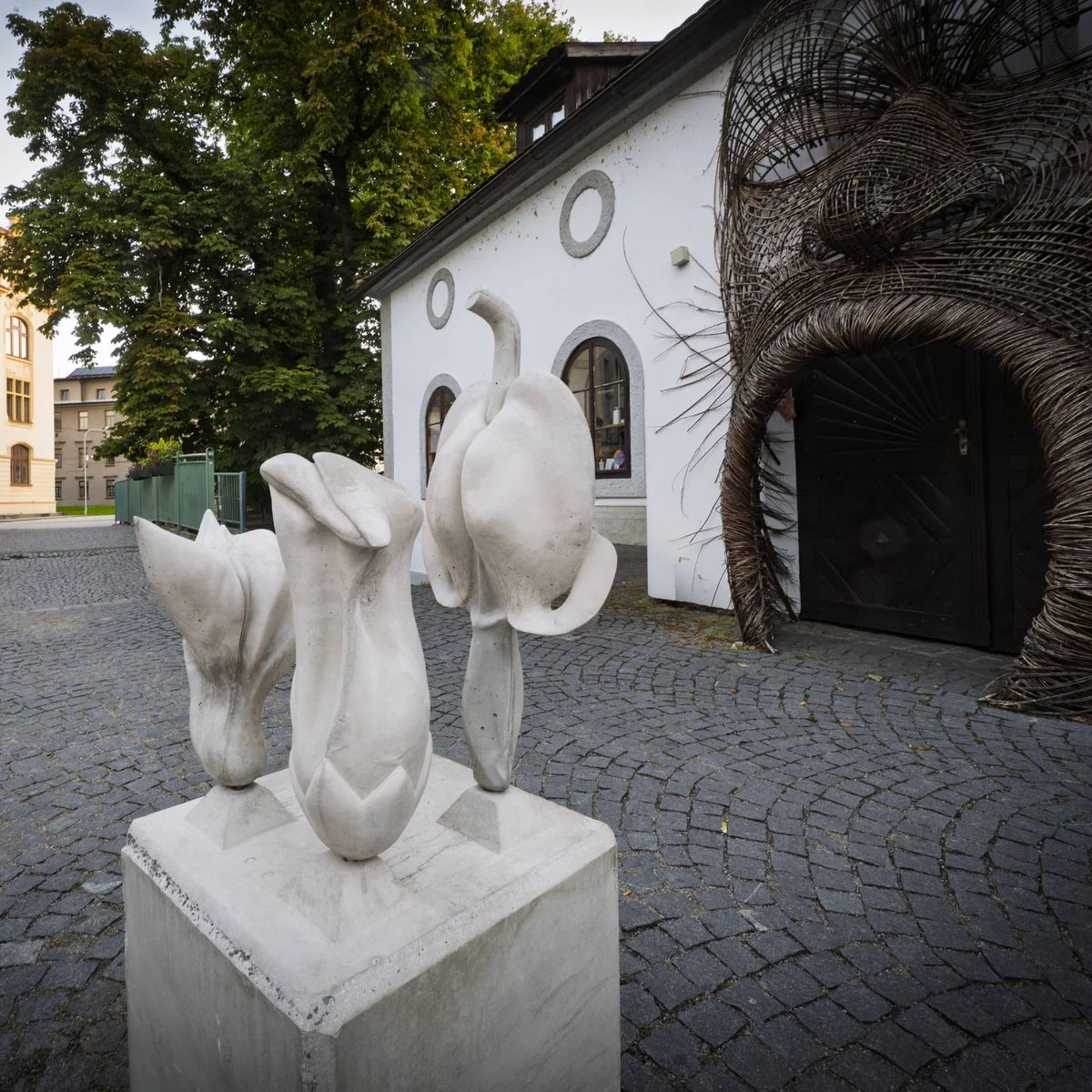
The sculpture Concrete Garden takes the form of a small garden made of pale concrete. Three separate sculptures stand on a massive plinth. The whole work is 120 cm tall; the plinth itself is a cube measuring 70 by 70 cm.
Each of the three sculptures resembles a plant at some stage of growth: a bud, a flower, a fruit or a fleshy leaf. All share the same light grey, faintly warm colour. The surface looks raw and matt, in places like a cast of concrete or pale stone.
The plinth is a simple tall block. It has the shape of a large cube with flat sides and sharp edges. Its surface is uneven, with small scuffs, smears and traces of dirt. Small low bases sit on the top face of the block. They are shaped like truncated pyramids: wider at the bottom, narrowing towards the top. Concrete plant forms grow out of three of them. One small base is left empty.
Two lower sculptures stand at the front. The one on the left resembles an open flower or chalice. It grows from a narrow neck which divides at the top into three broad, curving petals. The petals are thick and fleshy. Two are at the sides of the plant, the third at the back. Their ends open outwards, lift slightly and their tips point upwards. The inner space between the petals recalls the fruit of a pomegranate. The base of this fantastical plant is formed by another petal, a kind of pseudo-stem, which points downwards, touches the plinth and then curves back upwards through 180 degrees.
A narrower sculpture stands at the front right. It resembles the chalice of a slender flower with long petals, caught just before it opens. It has a tapered lower part and a slim body. Towards the top it opens gently into several petals. One of them curls inwards, forming a shape that recalls lips or a fold of skin.
Behind them stands the tallest sculpture, the most substantial of the whole composition. It is symmetrical, and its centre is formed by two large rounded leaves. They are broad and flattened. At first glance they recall lungs or the outline of an apple. They are convex, smoothly rounded and separated by a narrow slit running from top to bottom. From the upper part of the slit a long rounded shoot grows upwards. It first rises vertically and then bends slightly. Its end is cut off, like an open tube or a stem cut at an angle. Towards the ground the leaves open out, and from the lower part of the slit a narrow elongated form grows downwards. It resembles a flower just before it bursts open. The whole sculpture stands on it.
All the plant forms are simplified, yet they keep an organic character. They do not represent any particular species. Rather, they combine features of flowers, leaves and buds. Their forms are rounded, swollen and full of tension, as if something living were trying to grow out of the hard material. The objects may also evoke anatomical shapes and recall parts of the human body.
Fine traces of modelling are visible on the surface of every object. The petals have shallow grooves, soft transitions and small hollows. In places there are vertical lines resembling the veins of leaves or the marks left where moulds were joined. The edges of the petals can be sharp, but they are never as thin as those of real plants.
The sculpture works with the tension between the motif of nature and the material used – concrete. We usually associate flowers and buds with softness, growth and fragility; here they are cast in a heavy grey mass. Concrete Garden feels like a garden stopped in time.
How to find the sculpture
Havraní náměstí, Panská street, České Budějovice – in front of the entrance to the Rabenštejnská tower. Three separate sculptures stand on one massive cube-shaped plinth with 70 cm sides; the whole work is 120 cm tall. The plinth is a tall block, so the sculpture does not begin at ground level.