Beetles
concrete, ceramics
Areál Vodárenské věže, Mánesova ul.
Take a ride on the back of a beetle and discover life in the grass from a different perspective.
What the sculpture looks like
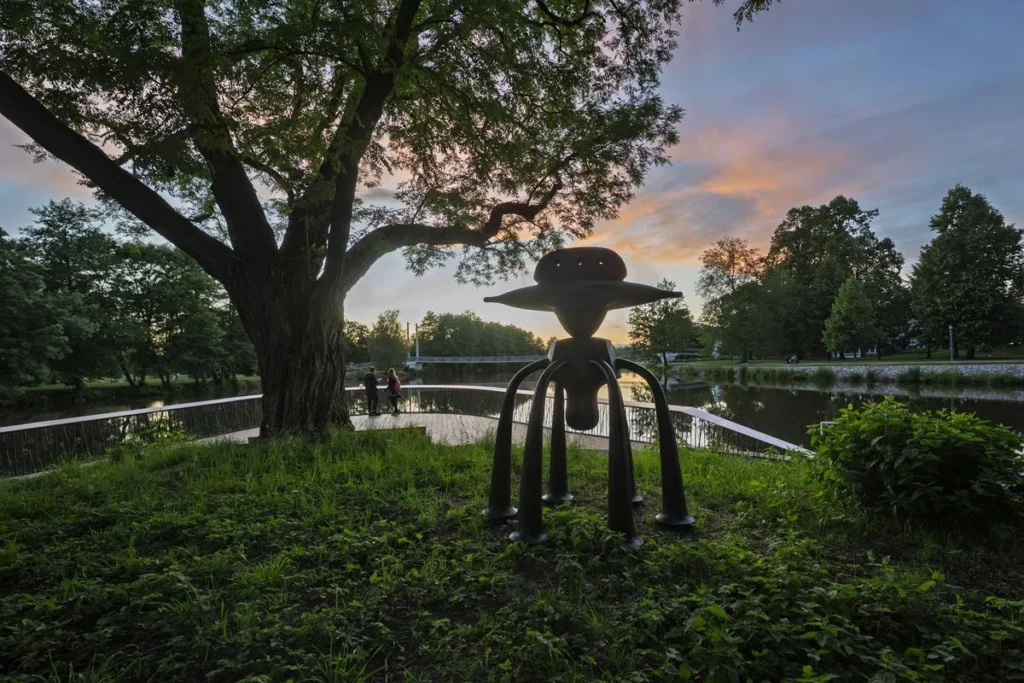
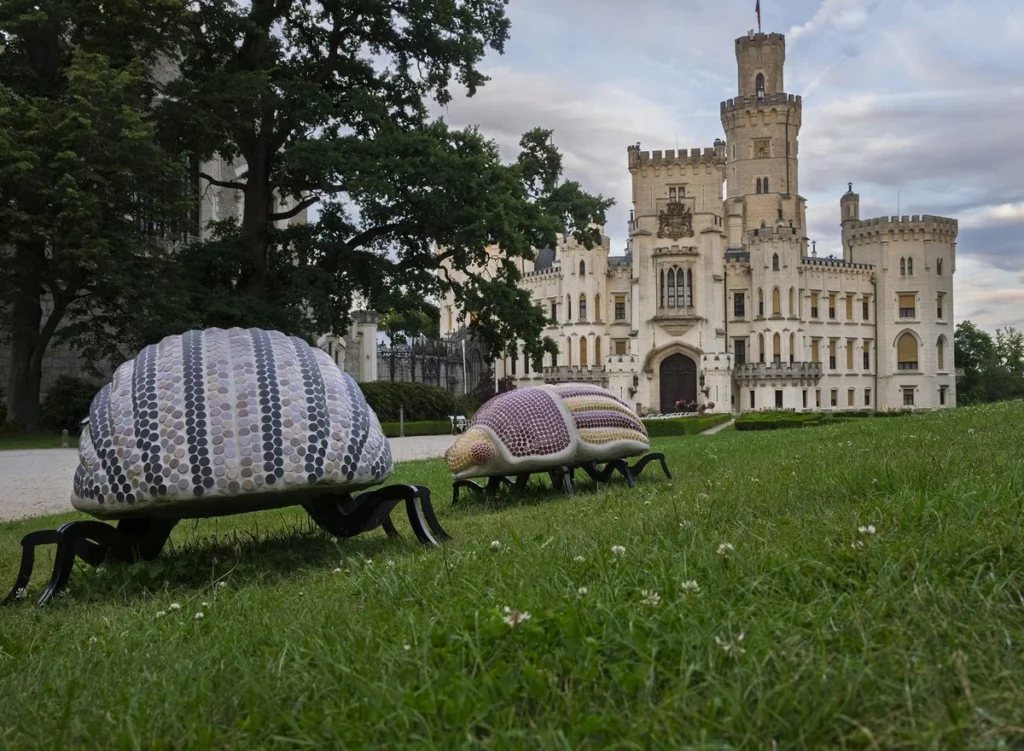
Beetles is a pair of large sculptures set on the lawn in the grounds of the Water Tower on Mánesova street. The objects represent two greatly enlarged beetles. This is not a realistic entomological model, yet there is no doubt about their identity. They are beetles – and beetles that have clearly enjoyed a hearty lunch, grown considerably, stepped out into the grass and decided to be an outdoor attraction for a while.
The sculptures are made of concrete and ceramics. The concrete forms the main, massive volumes of the bodies. The ceramics create the coloured circular elements covering their surface. Metal legs complete the composition.
Each beetle has a low, wide body roughly one and a half metres long. It is markedly bigger than a real insect, yet it stays close to the ground. The largest part of the object is the bulging oval abdomen. It has the form of a tall dome rounded on every side. It recalls a carapace, a shell, or an enormous ceramic loaf covered in dots. In front of the abdomen is a smaller rounded head, also strongly convex.
Each beetle stands on six black legs. The legs are long, thin and bent at an angle. They emerge from under the carapace and lift the body above the ground. They do not look massive. They resemble bent black rods. They touch the ground at only a few points, so the whole creature looks as if it might start running at any moment. Fortunately for visitors, it has no such plans.
The bodies of the beetles are a pale, creamy white and are covered with hundreds of small circular ceramic elements. These recall flat buttons, bottle caps or small mosaic tiles. They are arranged very densely and in regular rows. Because of them the surface is not smooth but rhythmic and finely articulated. Close up, the individual circles can be told apart. From a greater distance they merge into stripes and patterns on the carapace.
Vertical stripes predominate on the abdomens of both beetles. They run from front to back along the long axis of the body. Some stripes are white, others dark green. The green circles create clearly legible parallel lines separated by paler bands. On the upper part of one of the beetles there is also a triangular pattern made of dark green dots. It works like a sign set into the middle of the carapace. It does not disturb the shape of the beetle, but rather organises and emphasises it.
The carapace is clearly divided into a head and a larger rear part of the body. A pale smooth band runs between them. It works as a boundary between the front and rear parts of the insect. The abdomen reads as more unified and more dome-like. The head is lower, shorter and in its way more like a face – if such a thing can be said of a beetle made of concrete and ceramics.
The heads are the most colourful part of the pair. They are covered with dark green and white circles densely spread over the rounded surface. Red bulging areas sit at the sides of the head. They represent the beetles' eyes. They are large, intensely coloured and immediately draw attention. They give the beetles a slightly comic expression. As if they were looking, pretending to look, and at the same time surprised by their own size.
Both objects read as members of the same species, but not as two identical copies. Each has its own arrangement of dots, its own rhythm of stripes and its own character. Instead of beetles we would brush off a sleeve without thinking, here stand creatures worth stopping for, walking around and examining at leisure – by sight and by touch – to see just how many ceramic dots their carapace is actually made of.
How to find the sculpture
The Water Tower grounds, Mánesova street, České Budějovice. The two beetles stand freely on the lawn beside a shallow pool of water, each on six metal legs – they touch the ground at only a few points. The last few metres are across grass.
You may touch this sculpture