This year's exhibition also invited artists from abroad — Alex Suomi (Finland) and Tatiana Akimenko (Russia) — the architect Petr Tuček and the landscape architects Lenka Kulišťáková, Lenka Turková and Zdeněk Strnadel. Working with architects and landscape architects matters not only technically, when artists' ideas often exceed what a given material can do and have to be reasoned into shape with alternatives found for them, but in terms of ideas as well.
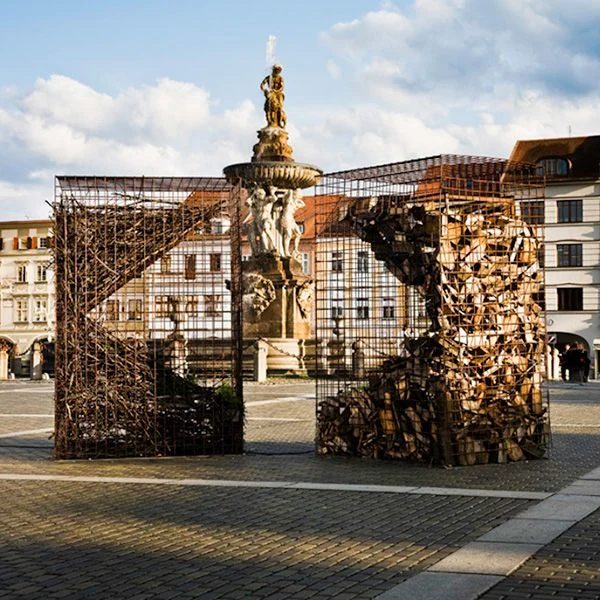
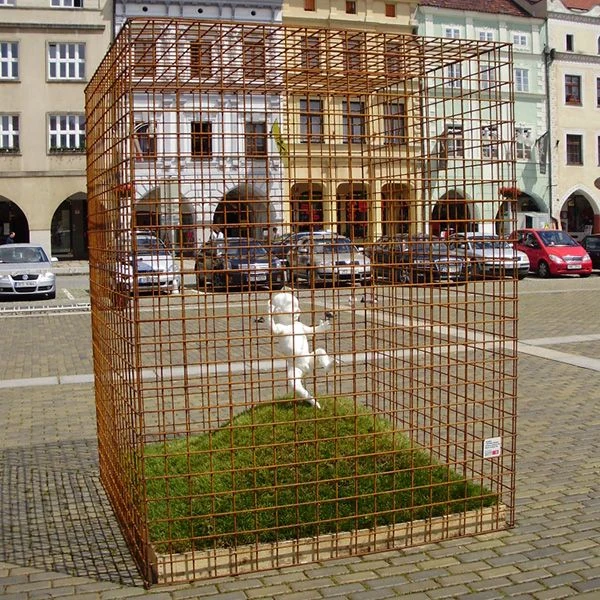
Sculpture and architecture have been bound together for thousands of years and complete one another. In recent decades, however, that coexistence has somewhat faded. Architecture has gone its own way and sculpture is slipping out of the average person's awareness. The concept of the exhibition was also shaped by last year's experience with vandals, when several sculptures were stolen and others damaged. Together with the architect Petr Tuček we began to develop the idea of architectural objects, cuboids, that would protect the works and at the same time link art, architecture and greenery. These cuboids — “sculpture cages” — also grow out of the chessboard ground plan of the square in Budějovice. That square is a very complicated space, mainly because of its size, but also a challenge we wanted to take up and deal with. We therefore decided to use at least part of it as a gallery, to translate a fragment of its ground plan into three dimensions and to build the whole installation on that principle, running out from the square into other places in the city. Each of the artists approached the cage in their own way. For some it was a display case for a work of art, as in the object titled Open-air Museum by Světlana Jelenová. Her work uses the cuboid as a temple or a museum in which a transcendent story plays out between heaven and earth — a story we are less and less able to live through.
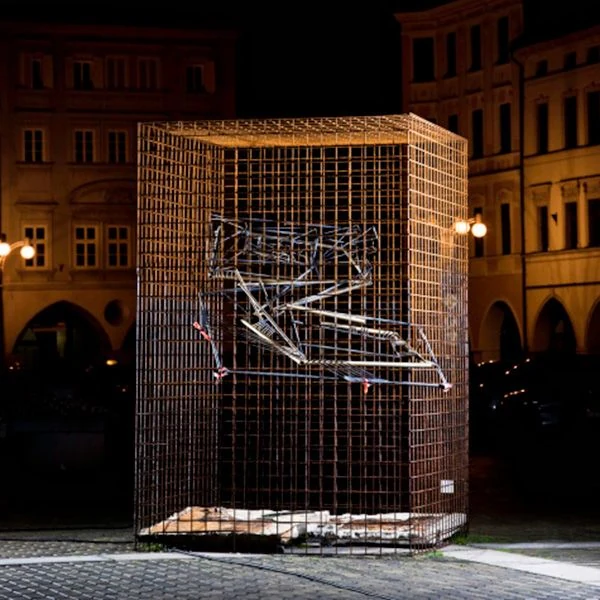
The figure of an infant (the Christ child) placed on a grassy mound works with the idea of cultural and spiritual values fading away, leaving form without spirit, so that what is admired is the architecture or the sculpture and no longer the substance they were created for. Jakub Flejšar used the cage as an architectural element combined with greenery in his work Forms of Nature. As he puts it himself: “I captured my relationship to nature. I am far more interested in nature and its calm than in the hectic pace of the city. The material therefore comes from nature, while the shape expresses the restlessness the present breathes. It is nature bound up in the confusion of the city.” It will also be interesting to watch the objects develop over time, because planters with greenery are built into them and the greenery will slowly grow through the sculpture and change it.
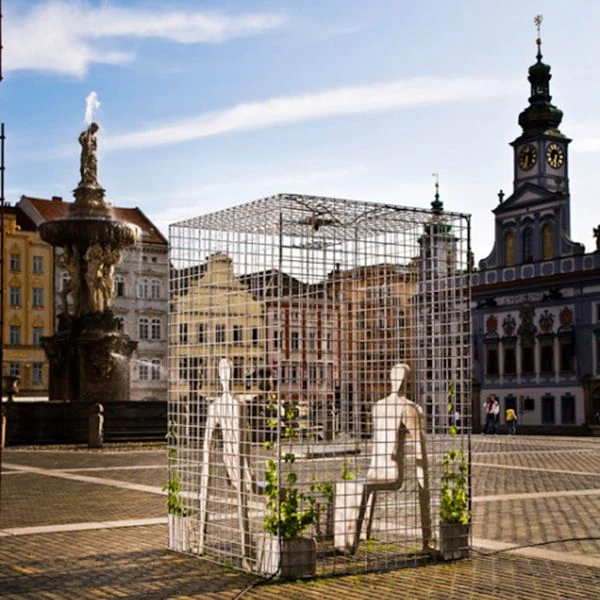
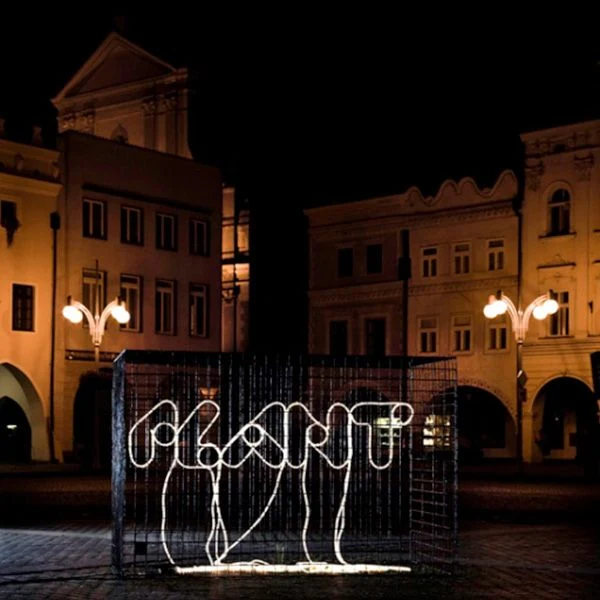
The cages will change every night, too, when artificial lighting built inside the sculpture brings out the structure of the individual pieces of wood and branches. The other “art cages” on the square are lit as well, and it is worth waiting for the night, when the atmosphere of the city changes just as the atmosphere of the individual lit objects does. A similar idea, concerned with change and with nature possibly disappearing from our lives, though in an entirely different form, was used by Adam Uchytil, currently a diploma student at the Academy of Arts, Architecture and Design in Prague, in his work “Caption”. It is a three-dimensional illuminated graphic bearing the word plant, which reads as a plant not only through the word but through its form. Its industrial, energy-hungry and artificial shape points to how often nature is replaced or imitated by something artificial, alien and often virtual, which can be sensed in the way the object changes between day and night. Another cage, working with the idea of joining architecture, sculpture and greenery, also on náměstí Přemysla Otakara II, was made by me (Michal Trpák), as a merging of dimensions. I opened my cage to dialogue between the space and the viewers.
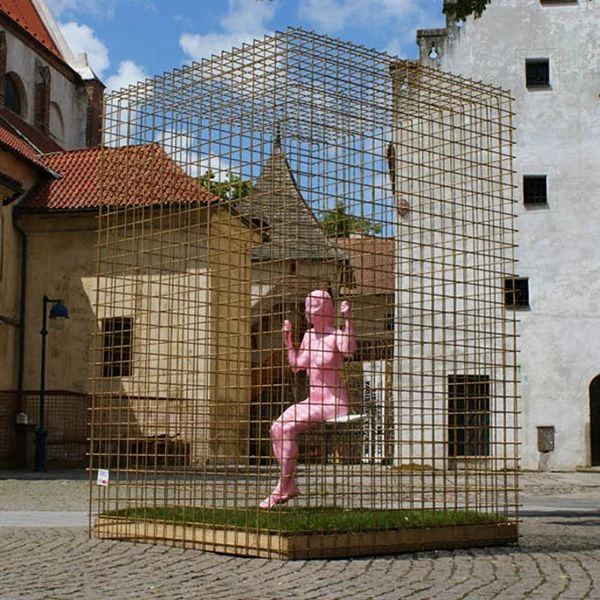
I therefore called the object Dialogues of Spaces. It is an intimate space with a minimalist, original interior that communicates with the place and invites passers-by to dialogue and play. The object works with the concept of organic green architecture, thanks to which it will keep changing until it is entirely swallowed by greenery — by hops. Another work of mine, placed on Piaristické náměstí, was inspired directly by the motif of the cage. The object is called “The Free Captive” — a sense of luxury and material freedom exchanged for captivity of the mind. Even the title carries a contradiction, underlined by a marzipan-pink girl floating above a green lawn on a swing, yet imprisoned in a golden cage.
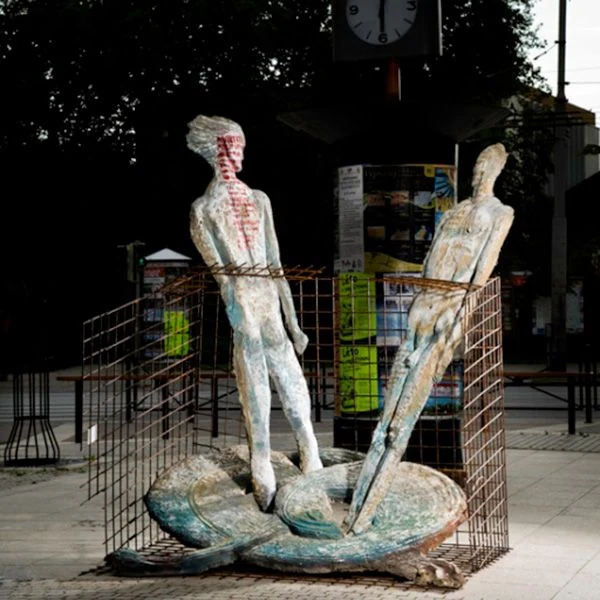
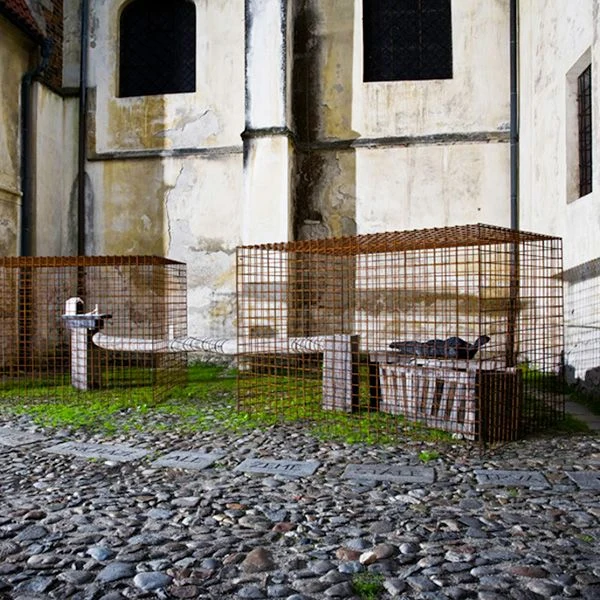
On Piaristické náměstí you can also see two cages by Martin Rajčan, in dialogue with one another and perhaps also somewhat opposed. The work is left untitled, to give the viewer more room for their own associations and stories. There are symbols here from which stories can be built, pointing to the material and the spiritual world, or simply the inscription in the paving that Rajčan might have ordered for his installation: “One generation passeth away, and another generation cometh: but the earth abideth for ever”… The work is completed by the atmosphere of the Piarist monastery and corresponds with its dignified, spiritual architecture. Returning to the main square, we find one more work, by the Finnish artist Alex Suomi. His cage works with the intersections of spaces, worlds and universes. In form, Suomi treated his cage seriously and dramatically. In the title and the idea, though, we can sense a certain grotesqueness, exaggeration, a paraphrase of science-fiction films. The title “Attack of the Lizards from Space” only confirms it and leads the viewer towards the story of the whole cage, cut through by the lizards' spaceship, with reliefs beneath it showing symbols of events on the surface of the planet. The last cage, of which only fragments remain, is a figurative object on the pedestrian zone of Lannova třída: “About That” by Tatiana Akimenko, a Russian artist and the wife of Alex Suomi.
The story of the figure and of people is played out here as a story that asks questions rather than counting on absolute answers. About that, about people, about life — a story we know, one that repeats itself and is different every time. The exhibition is not only about ideas, with the concept of joining architecture, sculpture and greenery as a manifesto and perhaps a suggestion for a “better”, different, more beautiful, more individual, more ecological or greener shaping of the space around us; it is also an attempt to point Czech viewers somewhere. Bringing new art into spaces dominated by classical art on the facades of buildings, or by no art at all, can speak to passers-by, move them and make them think about something that is not obvious, usual or normal at first glance, something that can provoke or raise questions. We would like to break the myth that ordinary people do not understand modern art.
We want people to reflect, to search, to think and to invent their own stories about these things, not to be afraid to say what they think and to provoke discussion and dialogue, and so to bring new elements into everyday life. People understand things that are ordinary to them, that they have already met, seen, tasted and heard many times. It is normal for them to form an opinion about food, music, a television programme or how their favourite football team played at the weekend. But that comes above all from frequent exposure to those things, and perhaps from their availability. That is why we bring art out into the streets — not only to confront art with real space, but above all with the viewer. We would like our exhibition to be a concept or a suggestion for the real shaping of space, of buildings, of cities: for architects to work with artists and garden architects, for those three professions to complete one another. If the viewer will not go to the gallery, we will put the gallery in their way. Once they have walked into it or tripped over it a few times, they may notice it. Once they notice it, they may think about it, and once they think about it, they will understand why art matters — or at least they may no longer find it amusing to destroy art or to dismiss it out of hand.
Michal Trpák
sculptor and founder of the exhibition