Gaia Lipenská
steel, glass
The sculpture Gaia of Lipno, made of recycled steel and glass, follows freely on from the sculpture created last year on the island of Alonissos in Greece. The monumental head evokes the feeling of a cathedral space of the mind. Entering this temple of the mind, visitors can slow down and contemplate the fragility of the ecosystems we are connected to. Inside the Gaia chapel they can connect with nature in contemplation or meditation. Each of us can look for answers to the questions of how we might live in greater harmony with the natural world. How can we reduce our ecological footprint and move towards practices that regenerate rather than exhaust the resources we depend on?
What the sculpture looks like
"Gaia of Lipno" is a monumental openwork sculpture in the shape of a human head. It shows only the head and neck, without a torso. It is a large sculpture, clearly bigger than a person. It is 3.5 metres high and about 2 metres wide. The sculpture feels light and almost translucent, although it is made of metal. Its main building material is dozens, or rather hundreds, of round hoops of various diameters joined into a single spatial net. There are practically no smooth walls or solid surfaces here. Everything is assembled from repeating circles: small, medium and large. Some are the size of a coin, others recall plates or small hoops. The closer to the edges of the face, the denser and more precise the arrangement.
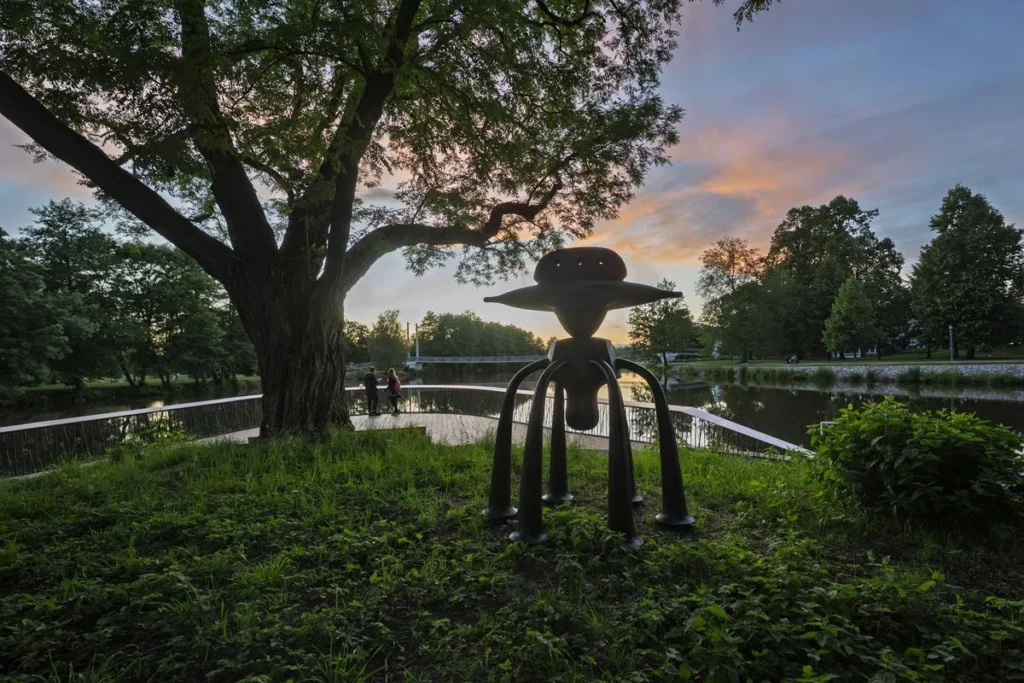
Context and surroundings matter for this sculpture. The object stands at the end of a jetty above the water. The end of the jetty is rounded. The sculpture was placed at the geometric centre of the walkable area. Its background is the surface of the lake, with vegetation and hills on the far shore.
The metal net of the object is dark, graphite in colour. The surface of the hoops is matt. It is precisely this dark drawing of lines that forms the outline of the head. The empty spaces between the circles remain as important as the metal itself. Because of them the sculpture is not a closed body but a form breathing with light and air. In some places coloured, semi-transparent glass discs have been set into the round openings. Compared with the number of empty circles there are only a few, but they draw the eye. Some are a saturated blue, like glass coloured with cobalt. Others are yellow, milky white, pale blue and red. These coloured elements do not form a regular pattern. They are scattered across the whole head as individual accents or points of light. Most can be seen in the area of the face and cheeks, though they also appear higher up, on the forehead and the vault of the skull. When a viewer comes closer to the object, the nature of these coloured elements is revealed. They have a structure resembling minerals or precious stones. They are crystalline. Their shape is irregular, made up of small facets, edges and fractures. They create sharp protrusions, fissures and glittering surfaces.
The sculpture stands on a low, round plinth. From it rises a short neck that lifts and supports the whole head. The neck is slender and slightly narrowed. The proportions of the head are subtly disturbed – this is most visible when the sculpture is seen in profile. The forehead passes smoothly into the bridge of the nose and then into a clearly projecting nose with a straight ridge. Below it a mouth is suggested. Beneath that, the line of the face passes into a rounded chin and on into the neck. The back of the head and the vault of the skull form a smooth, arched outline. The skull seems slightly elongated and domed upwards. This impression is strengthened by the shape of the ears, which lie close against the skull.
The sculpture does not depict a particular person. It is rather a synthetic, universal image of a head, calm and almost meditative. The figure has no hair and no realistic detail of skin. Instead the artist proposes a pure structure: the rhythm of circles, the emptiness between them and many accents of light and colour. Because of this, "Gaia of Lipno" joins two orders. On the one hand it is a clear representation of a human head. On the other it is an abstract, geometric and openwork construction in which rhythm and light seem to matter most. At night the object is lit. The black mesh of hoops dominates and is emphasised by cool white light. And the coloured inserts take on a glow.
How to find the sculpture
The jetty by the Molo restaurant, Lipno nad Vltavou. The sculpture stands at the end of the jetty above the water, in the geometric centre of the walkable area, on a low round plinth. The route runs along the jetty over the water.